By SK KutubuddinUpdated October 20, 2026

Heater Cost Per Hour Calculator
Enter any heater wattage to see the exact cost per hour, per day, and per month. Works for all heater types — oil, ceramic, infrared, fan, and more.
Enter any heater wattage to see the exact cost per hour, per day, and per month. Works for all heater types — oil, ceramic, infrared, fan, and more.
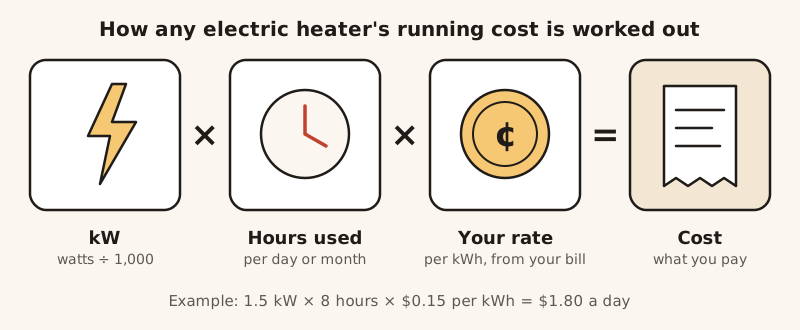
The formula is simple: divide your heater's wattage by 1,000 to get kilowatt-hours (kWh) per hour, then multiply by your electricity rate. For example, a 1,500W heater uses 1.5 kWh per hour. At the US average of 18.44¢/kWh, that's 1.5 × $0.1844 = $0.28 per hour.
This calculator works for any electric heater type — oil-filled radiators, ceramic heaters, infrared panels, fan heaters, and baseboard heaters. Cost per hour depends only on wattage and electricity rate, not on heater technology, and so does cost per month: all of them convert essentially all the electricity they draw into heat, so at the same wattage holding the same room at the same temperature they consume the same energy. Every thermostatic heater is switched off for part of each hour once the room is up to temperature, and how large that share is depends on the room's heat loss — insulation, glazing, outdoor temperature — not on which type of heater is sitting in it. The figures here assume rated wattage for every hour, so treat them as the ceiling.
For heater-specific versions of this calculator, try our oil heater cost calculator, ceramic heater cost calculator, or infrared heater cost calculator.
| Wattage | Cost/Hour | Cost/Day (4 hrs) | Cost/Day (8 hrs) | Cost/Month |
|---|---|---|---|---|
| 500W | $0.09 | $0.37 | $0.74 | $22.13 |
| 750W | $0.14 | $0.55 | $1.11 | $33.19 |
| 1,000W | $0.18 | $0.74 | $1.48 | $44.26 |
| 1,250W | $0.23 | $0.92 | $1.84 | $55.32 |
| 1,500W | $0.28 | $1.11 | $2.21 | $66.38 |
| 2,000W | $0.37 | $1.48 | $2.95 | $88.51 |
| 3,000W | $0.55 | $2.21 | $4.43 | $132.77 |
| 5,000W | $0.92 | $3.69 | $7.38 | $221.28 |
US average 18.44¢/kWh (EIA Electric Power Monthly, May 2026). Monthly column is 8 hrs/day for 30 days. Costs are for continuous running at rated wattage — a thermostat that holds the heater off for part of each hour lowers every column together, by an amount set by how fast the room loses heat rather than by the type of heater.
Your hourly cost is wattage multiplied by your electricity rate — nothing else. The only way to pay less per hour is to draw fewer watts or run fewer minutes. These four do one or both.

A 1,000W unit costs a third less per hour than a 1,500W one at the same rate. Wall-mounted with Wi-Fi control, so it can be scheduled rather than left running.
Check price on Amazon →
Widespread oscillation with two heat settings. Running the lower setting through a mild evening is the simplest saving available on any ceramic heater.
Check price on Amazon →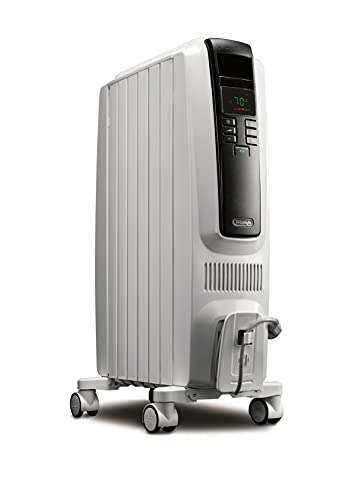
Oil-filled radiators suit overnight use because stored heat carries through thermostat-off periods. Use the reduced wattage setting and the hourly figure drops with it.
Check price on Amazon →
The timer caps how many hours get billed. If the number above surprised you, run-hours are usually the reason rather than the heater itself.
Check price on Amazon →