
Infrared Heater Wattage Guide
Find the right infrared heater size for your room, garage, or outdoor space. Avoid underpowered or oversized units with this free US sizing guide.
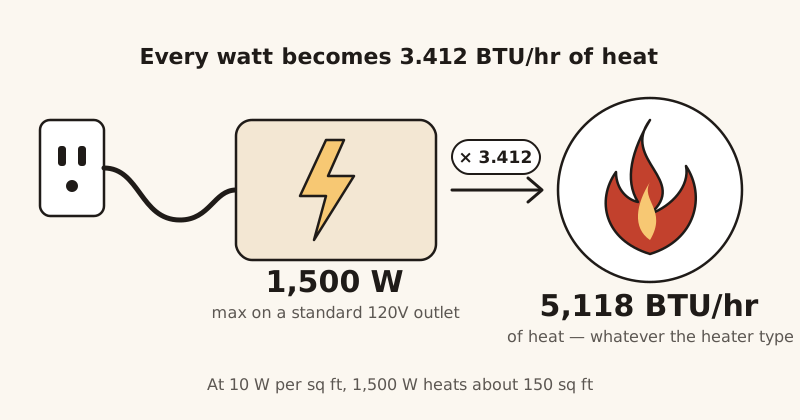
Use 10 watts per square foot as a baseline for infrared heaters in an average-insulated room. A 150 sq ft room needs ~1,500W. A 300 sq ft room needs ~3,000W. Add roughly 25% for a drafty or poorly insulated space. Outdoors the rule does not apply at all — size a patio heater by the coverage the manufacturer states.
Infrared Heater Size Guide by Room Size
| Space | Sq Ft | Watts Needed | Recommended Model |
|---|---|---|---|
| Small bedroom | 100 | 1,000W | 750W may be enough if well insulated |
| Medium bedroom | 150 | 1,500W | The standard 1,500W plug-in unit |
| Living room | 250 | 2,500W | One 2,500W unit or two 1,250W units |
| Large room | 300 | 3,000W | 3,000W — needs its own circuit |
| 1-Car garage | 250 | 2,500W and up | Size up: garages are rarely insulated |
| 2-Car garage | 500 | 5,000W and up | Two 2,500W units, hard-wired |
| Outdoor patio | — | Not sized by area | Use the maker's coverage radius |
Based on about 10 watts per square foot for an average-insulated room — the rule this site uses throughout. Well-insulated rooms need less; drafty ones need more. For scale, 1,500W is only about 5,100 BTU/hr, which is why a 1,500W heater suits roughly 150 sq ft and not the 750–1,500 sq ft some product listings advertise. Where a manufacturer quotes a much larger coverage figure, treat it as a marketing claim.
Calculate the Right Infrared Heater Size
How to Choose the Right Infrared Heater Wattage
The standard rule for infrared heaters is 10 watts per square foot for an average-insulated indoor space. A 150 sq ft bedroom needs roughly 1,500W. A 300 sq ft living room needs around 3,000W for comfortable warmth at typical US winter temperatures. Put the other way round, 1,500W — the most common plug-in size — is about 5,100 BTU/hr and suits about 150 sq ft, so treat product listings promising 750 or 1,500 sq ft from a 1,500W unit as marketing rather than sizing.
A drafty or poorly insulated space — most garages — needs more than the rule suggests, because the room loses heat faster than a well-sealed one; adding about a quarter is a reasonable starting point. Outdoors the square-foot rule stops meaning anything: an open patio has no envelope to hold warm air, and a radiant heater out there is warming people and surfaces directly. Size a patio heater by the coverage area and mounting height its manufacturer states, not by floor area, and compare that against an equivalent indoor room.
For large garages and workshops consider using multiple smaller infrared heaters rather than one large unit. Two 2,500W heaters positioned at opposite ends of a 500 sq ft garage distribute heat more evenly than a single 5,000W unit mounted in one location. See our infrared heater cost calculator to estimate your running costs.