
Infrared vs Electric Heater Cost
Both use electricity but they heat differently. Here is the full cost comparison for US homeowners.
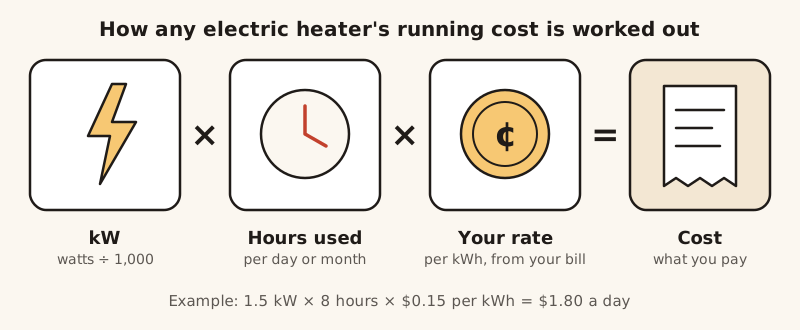
A 1,500W infrared heater and a 1,500W convection heater draw identical electricity — $0.28 an hour at 18.44¢/kWh, about $66 a month at 8 hrs/day. Both are electric resistance heaters converting essentially 100% of their input into heat, so there is no efficiency gap between them and no discount hiding in the technology.
What differs is where the heat lands. Infrared radiates onto people and objects, so you feel warm within seconds even in a cold garage, and a good panel puts roughly 65% of its output out as radiation (IEC 60675-3 sets a 40% floor for anything sold as an infrared heater). Convection warms the air first, which takes five to fifteen minutes but leaves the whole room comfortable. If the immediacy of infrared leads you to switch off sooner, you save — but the saving comes from the hours you did not run it, and it would come just the same from switching off a convection heater sooner.
EIA Electric Power Monthly, Table 5.6.A, May 2026. Choose infrared for garages, workshops, patios and rooms used briefly; choose convection for a room you want evenly warm for hours. Use the calculator below to compare your own wattages and run hours.
A 1,500W infrared heater and a 1,500W electric convection heater cost exactly the same to run — $0.28/hour at the US average 18.44¢/kWh. Both convert essentially 100% of their input into heat. The difference is where the warmth lands, not what it costs.
Compare Infrared vs Electric Heater Cost
Infrared vs Electric Heater — Full Comparison
| Feature | Infrared | Electric Convection |
|---|---|---|
| Cost per hour (1,500W) | $0.28 | $0.28 |
| Cost per month (8 hrs/day) | ~$66.38 | ~$66.38 |
| Efficiency | 100% of input becomes heat | 100% — identical |
| Heat-up time | Instant | 5–15 mins |
| Heats | Objects & people | Air |
| Radiant share of output | ~65% for a good panel (40% minimum under IEC 60675-3) | Low — mostly convective |
| Works in a draughty space | Yes — you feel it regardless of air temperature | Poorly — warm air escapes |
| Room coverage (1,500W) | ~150 sq ft | ~150 sq ft |
| Best for | Spot / intermittent | Continuous |
| Noise level | Silent on panels; some quartz units have fans | Silent on convection panels; fan models 40–55 dB |
| Safety near children | Panels cool-touch; quartz elements very hot | Gets hot |
1,500W, 8 hrs/day, 30 days at 18.44¢/kWh (EIA Electric Power Monthly, Table 5.6.A, May 2026). The two cost columns are identical because both heaters are electric resistance — the rows that differ are the ones worth choosing on. Coverage uses the 10 W/sq ft sizing rule for an average-insulated room.
Infrared vs Electric — What Is the Real Difference?
Infrared and electric convection heaters cost exactly the same to run, because both convert essentially 100% of the electricity they draw into heat. A 1,500W unit of either type costs $0.28 an hour at the US average rate of 18.44¢/kWh — about $66 a month at 8 hrs/day. Use our 1500-watt heater cost guide to see the full monthly breakdown at your own rate.
The practical difference is in how they heat. Infrared warms people and objects directly with radiant heat — similar to sunlight — so you feel warm immediately even in a cold room. A good infrared panel puts out roughly 65% of its energy as radiation; IEC 60675-3 sets a 40% floor for anything sold as an infrared heater, and claims above about 70% should be treated with suspicion. Convection heaters warm the air, which then warms the room gradually over five to fifteen minutes.
That distinction matters most where heating the air is futile. In a garage, on a patio, or in a workshop with the door opening every few minutes, warm air leaves as fast as you make it, while radiant heat still reaches you. In a well-insulated room used for hours at a time, convection gives a more even, comfortable temperature throughout the space. Neither choice changes the meter reading for a given wattage and run time.
One caution on sizing, whichever you pick: 1,500W is only about 5,118 BTU/hr, which suits roughly 150 sq ft of average-insulated room at the standard 10 watts per square foot rule. Box claims of 750 or 1,000 sq ft for a 1,500W heater are marketing figures. See the full space heater cost calculator to compare more heater types.
Infrared & Electric Heater Picks
Affiliate disclosure: we earn from qualifying purchases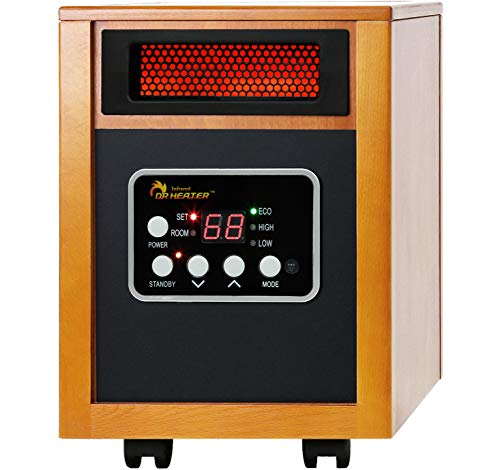
Dual infrared + convection system with auto thermostat and remote, wall-mountable or freestanding, 12-hour timer. Dr Infrared advertises 1,000 sq ft; at 1,500W the 10 W/sq ft rule puts realistic coverage nearer 150 sq ft.
View on Amazon →Flat panel design mounts flush to wall or ceiling. No moving parts, so it is completely silent, and warmth is felt within about 30 seconds. Ideal for bathrooms, offices and small bedrooms where a fan heater would be intrusive.
View on Amazon →
Wall-mount infrared quartz heater with WiFi control, Google/Alexa compatible. Ideal for garages where floor space is limited and radiant heat beats warming the air. Heat Storm advertises 750 sq ft; a realistic figure for 1,500W is about 150 sq ft.
View on Amazon →Compact 1,500W ceramic convection heater with built-in thermostat. Great for heating a room to a set temperature and maintaining it. Simple, reliable, affordable.
View on Amazon →