
Water Heater Cost Calculator
Find out exactly what your water heater costs per month — electric, gas, or heat pump. Free US tool.
Calculate Your Water Heater Running Cost
Water Heater Monthly Cost Comparison
| Type | 1–2 People (38 gal/day) | 3–4 People (55 gal/day) | 5+ People (84 gal/day) |
|---|---|---|---|
| Electric Tank (UEF 0.92) | ~$38/mo | ~$55/mo | ~$84/mo |
| Gas Tank (UEF 0.64) | ~$15/mo | ~$21/mo | ~$32/mo |
| Heat Pump WH (UEF 3.5) | ~$10/mo | ~$14/mo | ~$22/mo |
| Tankless Electric (UEF 0.99) | ~$35/mo | ~$51/mo | ~$78/mo |
| Tankless Gas (UEF 0.84) | ~$11/mo | ~$16/mo | ~$24/mo |
Electricity 18.44¢/kWh (EIA Electric Power Monthly, Table 5.6.A, May 2026 — a single month, not an annual average). Natural gas $1.44/therm (EIA, winter average, November 2025 - March 2026 (US); December 2025 - February 2026 (by state)). Hot water volumes are the DOE UEF draw patterns (low 38, medium 55, high 84 gal/day), heated from 58°F to 125°F. UEF ratings already include tank standby loss, which is why a gas tank rates 0.64 while its burner is about 80% efficient. Monthly figures are annual cost divided by 12. The heat pump figure of UEF 3.5 is our modelling assumption for a current ENERGY STAR unit in a warm space.
Which Water Heater Is Cheapest to Run?
Heat pump water heaters are the cheapest to run in most US climates — about 74% less than a standard electric tank at rated efficiency. For a household drawing DOE’s medium pattern of 55 gallons of hot water a day, that is roughly $173 a year against $658 for the electric tank, a saving of about $485 a year. ENERGY STAR puts the saving for a family of four at 3,760 kWh a year — $550 at the 14.6¢/kWh it assumes, or about $693 at the current US average of 18.44¢/kWh.
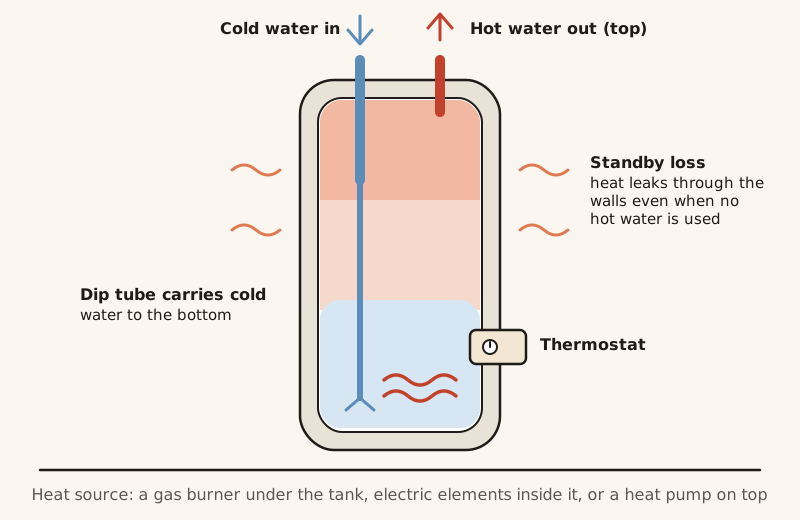
Gas tank heaters are the second cheapest option where natural gas is available, at roughly $252 a year for the same hot water. Tankless gas costs less again — but the reason is standby loss, not burner efficiency. A gas storage tank rates a UEF of only 0.58–0.70 because it reheats a standing tank around the clock, while a non-condensing gas tankless rates 0.81–0.87 and a condensing one 0.93–0.97. DOE puts the tankless saving at 24–34% for homes using 41 gallons a day or less, falling to 8–14% for homes using around 86 gallons a day, because the more hot water you draw the smaller a share standby loss becomes. See the full gas vs electric heating cost breakdown for a detailed comparison.
Electric tank heaters have the highest running cost of the mainstream options and the lowest purchase price. Low-rate states narrow the gap against gas without closing it: nationally an electric tank costs about 2.6x what a gas tank costs to run, falling to about 1.9x in Washington (14.95¢/kWh) and about 2.0x in Louisiana (14.15¢/kWh). If you are on electricity and staying in the house, the comparison that matters is not gas versus electric tank but heat pump versus electric tank. Use the heat pump cost calculator to compare options for your location.
Rates: electricity 18.44¢/kWh (EIA Electric Power Monthly, Table 5.6.A, May 2026); natural gas $1.44/therm (EIA, winter average, November 2025 - March 2026 (US); December 2025 - February 2026 (by state)). Hot water heated from 58°F to 125°F, the DOE UEF test conditions.
Water Heater Cost — FAQs
What Actually Cuts a Water Heating Bill
Water heating is usually the second largest load in a US home. Three things move the number: how much hot water you draw, how much heat the tank loses while idle, and how many hours it is allowed to reheat. A cheaper tank does not help — these do.

Showers are the largest hot water draw in most homes, so cutting flow cuts the bill directly. Pressure compensation keeps the spray usable at the lower rate, which is what makes a low-flow head tolerable.
Check price on Amazon →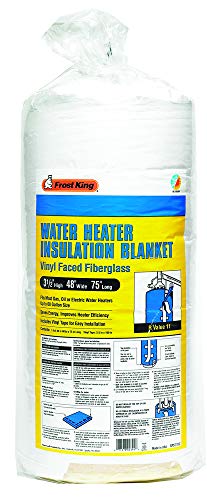
An uninsulated tank loses heat continuously, then reheats. Wrapping it attacks that standby loss rather than your usage. Electric tanks only — on a gas heater the draft hood and burner air intake must stay clear.
Check price on Amazon →
Stops the element reheating a full tank while everyone is asleep. Worth most if your utility has off-peak rates; worth something regardless, because a tank reheated once a day loses less than one reheated all night.
Check price on Amazon →
No tank means no standby loss at all — it only draws power while water is flowing. Needs serious electrical capacity, so check your panel before buying. Best suited to smaller homes or a single-point replacement.
Check price on Amazon →More Water Heater Cost Guides
Related Calculators