
Gas Water Heater Running Cost
See exactly what your gas water heater costs per day, month and year at current US gas rates.
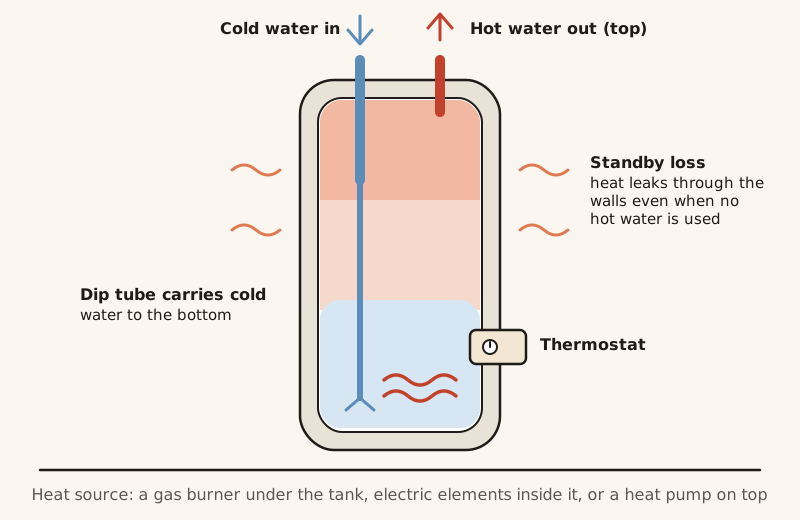
A gas storage water heater costs roughly $0.69/day, $21/month and $252/year for a household drawing 55 gallons of hot water a day — DOE’s medium-use draw pattern — at the US average gas rate of $1.44/therm. That is about 175 therms a year.
Calculate Gas Water Heater Cost
Gas Water Heater Monthly Cost by Type
| Type | 1–2 People (38 gal/day) | 3–4 People (55 gal/day) | 5+ People (84 gal/day) |
|---|---|---|---|
| Gas storage tank (UEF 0.64) | ~$15/mo | ~$21/mo | ~$32/mo |
| Tankless, non-condensing (UEF 0.84) | ~$11/mo | ~$16/mo | ~$24/mo |
| Tankless, condensing (UEF 0.95) | ~$10/mo | ~$14/mo | ~$22/mo |
Natural gas $1.44/therm — EIA, winter average, November 2025 - March 2026 (US); December 2025 - February 2026 (by state). Volumes are the DOE UEF draw patterns (38 / 55 / 84 gal/day) heated from 58°F to 125°F. Figures are Uniform Energy Factors, not combustion efficiency: a gas tank burns at roughly 80% but rates only 0.58–0.70 once round-the-clock standby loss is counted, which is the loss tankless removes. Real DOE bands are 0.81–0.87 for non-condensing tankless and 0.93–0.97 for condensing. Monthly figures are annual cost divided by 12. Because a single UEF is applied at every draw volume, this table does not reproduce DOE’s usage-dependent savings band (24–34% at 41 gal/day or less, 8–14% at around 86 gal/day) — treat it as a mid-range estimate.
Gas Tank vs Tankless Gas Water Heater Cost
Tankless gas water heaters cost less to run than gas tanks, but not for the reason usually given. The difference is standby loss, not burner efficiency. A gas storage tank burns at roughly 80%, yet rates a Uniform Energy Factor of only 0.58–0.70 because it reheats a standing tank around the clock whether you use it or not. A non-condensing tankless rates 0.81–0.87 and a condensing one 0.93–0.97. DOE puts the saving at 24–34% for homes drawing 41 gallons a day or less, falling to 8–14% at around 86 gallons a day — the more hot water you use, the smaller a share standby loss is, and the less tankless saves you.
Gas tank heaters have lower upfront costs and simpler installation. In cash terms the running-cost gap is small: at DOE’s medium draw of 55 gallons a day it is about $21/month for a tank against $16/month for a non-condensing tankless, and at the low-use pattern of 38 gallons a day about $15 against $11. A few dollars a month takes a long time to repay the extra install cost, so tankless earns its place mainly on lifespan and on never running out of hot water, not on the energy bill.
Gas prices vary far more than equipment does. Across the 50 states and DC the winter residential price runs from about $0.67/therm in Idaho to about $5.17/therm in Hawaii, against a national average of $1.44. Use the calculator above with your own rate. You can also compare against electric water heater running costs or view the full water heater cost calculator to compare all types side by side.
Gas rates: EIA Natural Gas Monthly, residential price by state, winter average, November 2025 - March 2026 (US); December 2025 - February 2026 (by state). Hot water heated from 58°F to 125°F, the DOE UEF test conditions. Where EIA withheld a state’s winter figure, a fallback is used.
Gas Water Heater Cost — FAQs
Cutting a Gas Water Heating Bill
With gas, your bill is therms burned, and a tank burns them in two places: heating the water you actually use, and reheating after standby loss. Reducing draw helps most, because every gallon you do not use is gas you do not burn.

The cheapest change with the clearest effect. Less hot water drawn means fewer therms burned to reheat, and the saving applies every single shower regardless of what your tank costs to run.
Check price on Amazon →
Bare hot water pipes shed heat the whole way from tank to tap, which is why the first few litres run cold and get wasted. Insulating the accessible runs is a twenty-minute job.
Check price on Amazon →
Lets the tank store hotter while still delivering water at a safe temperature, so you get more usable hot water from the same tank. Fit it if you keep running short before the end of a shower.
Check price on Amazon →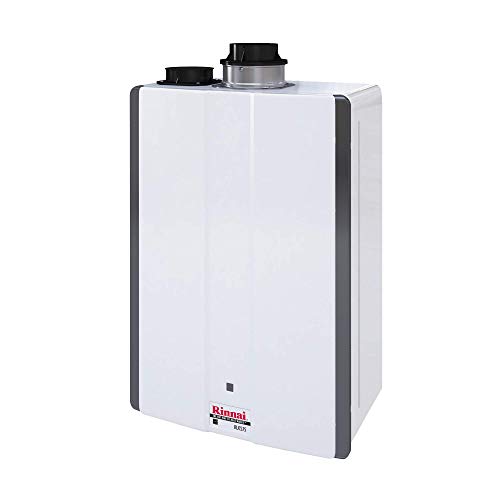
Burns gas only while water flows, which removes standby loss entirely. It is a plumbed installation with venting requirements, so treat it as a replacement project rather than a weekend purchase.
Check price on Amazon →Related Water Heater Cost Guides
Compare running costs across all water heater types.
Full running cost guide for electric tank heaters.
See how much a heat pump water heater saves vs gas.
Free US heating cost tools for every heater type.