
How Much Does It Cost to Heat a House?
Get a realistic monthly heating cost estimate for your home based on size, fuel type, and local rates.
EIA forecast that US households would spend $640 on heating with natural gas and $2,115 with heating oil across November 2025 to March 2026 — about $128–$423 a month, depending on fuel. For a specific house, the heat-loss model on this page gives about $168 a month for an average-insulated 2,000 sq ft home on gas, $200 on a heat pump, $397 on propane and $561 on electric resistance heat.
House Heating Cost Estimator
What actually lowers a heating bill
Affiliate disclosure: we earn from qualifying purchases
The Department of Energy puts a 7–10°F setback for 8 hours a day at up to 10% off a year’s heating. A learning thermostat builds that schedule around when you are home, so it actually happens. For 24V gas, oil and heat-pump systems, not line-voltage baseboard heaters.
View on Amazon →
Comes with a SmartSensor, so it can heat to the room you are actually in instead of the hallway the thermostat hangs in. Also handles a heat pump with gas backup. Same caveat: 24V central systems only, not baseboard heaters.
View on Amazon →
A foam draft stopper that runs along the bottom of a door. Fit one to any exterior door, or to the door of a room you do not heat, wherever you can feel cold air coming under it.
View on Amazon →
Be realistic about what curtains do: the Department of Energy puts conventional draperies at about 10% less heat lost through the window. Worth it on your coldest windows; open south-facing ones on sunny days.
View on Amazon →Cost to Heat a House by Size and Fuel Type
| Home Size | Natural Gas | Electric | Heat Pump | Propane |
|---|---|---|---|---|
| Small (~1,000 sq ft) | ~$101/mo | ~$337/mo | ~$120/mo | ~$238/mo |
| Medium (~2,000 sq ft) | ~$168/mo | ~$561/mo | ~$200/mo | ~$397/mo |
| Large (~3,000 sq ft) | ~$252/mo | ~$841/mo | ~$300/mo | ~$595/mo |
One winter month averaging 35°F outdoors, average-insulated homes, whole-house heat loss of 300, 500 and 750 BTU/hr per °F respectively. Gas furnace 92% AFUE at $1.43/therm (EIA winter average, Nov 2025–Mar 2026); electric resistance 100% and heat pump seasonal COP 2.8 at 17.72¢/kWh (EIA Electric Power Monthly, winter 2025–26 average); propane furnace 80% AFUE at $2.69/gal (EIA heating-season average, Oct 2025–Mar 2026). Insulation, air tightness and thermostat setting move these figures more than fuel price does.
What Drives Your Heating Bill?
Your bill is the product of two things: how much heat the house loses, and what you pay per unit of heat to replace it. An average-insulated 2,000 sq ft home in a winter month averaging 35°F outdoors needs roughly 10.8 million BTU of delivered heat. Buying that heat costs about $168 with a gas furnace at $1.43/therm, $200 with a heat pump, $397 with propane, and $561 with electric resistance heat.
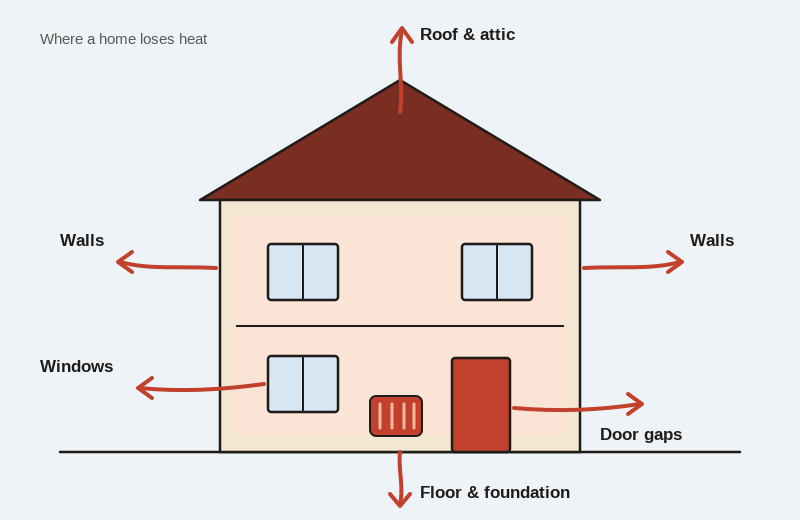
The building envelope moves the first number, and it is the half you can permanently change. ENERGY STAR puts air sealing together with attic, floor and crawlspace insulation at an average saving of 15% of heating and cooling costs — around 11% of a household’s total energy. Air leakage alone is 25–40% of heating energy loss in homes built before 2000, which is why a caulk gun and a weekend often beat another layer of attic insulation.
The thermostat moves it too. The Department of Energy’s guidance is a 7–10°F setback held 8 hours a day, which it puts at about 10% a year off heating and cooling — one annual figure, not a per-degree-per-hour rule. For scale, EIA forecast household heating spending across November 2025 to March 2026 at $640 on natural gas and $2,115 on heating oil, which is roughly $128–$423 a month; those are October 2025 forecasts rather than measured outturn. For state-specific rates and bills, visit our heating cost by state page or use the state comparison tool.